

WATER RETURNS
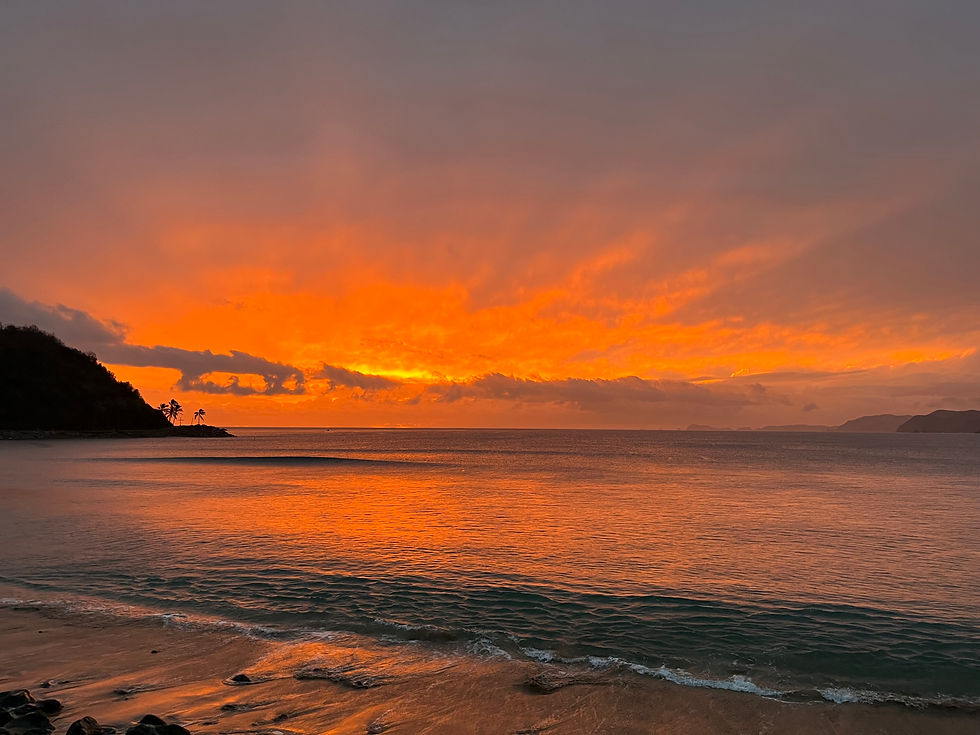
At Es Vedrà, the body quiets before the mind understands why.
As I reached the edge of the cliff where the dirt trail ends, the rock rose from the sea with a kind of stillness that did not feel passive. It felt ancient, complete, and inevitable. Around it, everything was moving. The water changed color and shimmered with the mid-morning light, while heat gathered on my shoulders and a cool breeze moved over my skin with just enough push to take the edge off the sun. The taste of salt sat faintly on my lips as sweat dried from the hike. Birdsong came in fragments, occasionally crossed by the low hum of boat engines moving through the water far down below. The horizon kept widening until my mind stopped trying to hold it all.
I had come to Ibiza for a technology conference, and I spent my last day exploring this corner of the island before flying back to Málaga.
Standing there, the residue from the week began to settle.
There were no panels, no stage, no schedule. Only rock, sea, wind, sky, and the slow adjustment of my own nervous system as the conversations, introductions, screens, new names, questions, and possible collaborations kept moving through me. Technology, longevity, investment, hospitality, cities, work, human connection, what the future might ask of us, and what kind of lives we would need in order to meet it.
I did not want any of that to disappear. I needed it to settle.
Some experiences do not need to be cleared out of the body. They need enough space to integrate. They need the mind to stop sorting and the body to start metabolizing. They need light, air, time, distance, and the kind of silence that does not demand anything in return.
That is what Es Vedrà gave me.
The conference took place at Auditori Caló de s’Oli, an open-air amphitheater overlooking Portmany Bay, the kind of place built for gathering without sealing people away from their surroundings. The stage sat below the audience, tucked into the slope above the water, so the speakers occupied the foreground while the sea remained quietly inside the frame. The screens, branding, microphones, speaker transitions, and occasional technical difficulties all belonged to the event, but behind them the Mediterranean kept doing what it had been doing long before any of us arrived.
You could feel the design of the place in the body before thinking about it as design. Large sheets stretched overhead provided shade across much of the seating area, though the angle of the sun in the early morning and late afternoon left some sections more exposed than others. The air carried that coastal mix of salt, sunscreen, coffee, dust, and dry plants. People settled onto benches and cushions, passing cups, adjusting sunglasses, opening notebooks, checking phones, and leaning forward when a sentence landed.
The formal topics moved across AI, sports tech, healthspan, mobility, investment, hospitality, cities, human connection, and the future of work, but it was hard to listen to people speak about what comes next without also feeling the conditions around the conversation.
The question underneath was not stated exactly this way, but it was present throughout:
How do we build ways of living, working, moving, and connecting that can keep adapting without exhausting the people inside them?
It appeared whenever a panel moved from technology to productivity, from sport to connection, from tourism to place, from investment to human experience. The vocabulary changed, but the tension did not. We need better tools, better design, and more coherent conversations between people who usually stay in separate rooms. At the same time, the setting kept reminding me that no design remains abstract once a body has to live inside it.
That stayed with me.
Even there, surrounded by sea and sky, attention still had to keep defending itself. The panels asked for focus while side conversations rose and fell at the edges. Phones lit up, transitions filled the pauses, applause marked the shifts. None of it was unusual, which was part of the point. The modern instinct is to fill the gap before the gap can do its work.
I noticed this again while walking through the Sunset Strip in Sant Antoni, though a first visit only allows impressions. The sea was close enough to orient the whole scene, but sound seemed to arrive from every direction before the water could. Music spilled from terraces. Menus caught the light outside restaurants. Waiters moved between tables. Party bracelets were offered left and right, while different invitations came in lower voices from the sides. People drifted past in beach clothes and linen, already dressed for the evening before the day had fully ended. Sunglasses, perfume, sunscreen, cigarette smoke, the sweetness of cocktails, the salt of the bay, the soft fatigue of sun on skin. Everything had a surface charge to it.
There was pleasure in it, and color, and the ordinary human desire to gather somewhere beautiful. But I could also feel how quickly the place turned beauty into atmosphere, and atmosphere into stimulation. Even the pauses seemed filled in advance.
Underneath all of that, the island kept offering the opposite.
Rock. Salt. Heat. Dust. Water. Distance.
Silence asks more of us than sound does. Sound carries us. Silence returns us to ourselves.
Maybe that is why the conference setting stayed with me so strongly. People had come to speak about technology and the future, but the place kept redirecting me toward the older question of conditions.
Sitting there brought something back into view. I have lived near water for most of my life, though not always in the same way.
In Lima, the Pacific was part of my childhood. It was the edge, the horizon, the weather, and often the place the day seemed to move toward. Even when it was not directly in front of me, it shaped the feeling of the city. The air carried it in the mist of winter mornings. The sky belonged to it during summer outings in the southern beaches. There was always an edge somewhere, a place where the cliffs dropped into the ocean and you could stand looking out at miles of water with nothing to interrupt the view.
In New York, water framed much of my adult life, even when the city made it easy to forget the body had rhythms older than ambition. The Hudson River, the tidal waters of the East River, bridges, ferries, waterfront walks, the Atlantic not far away. The city was hard, vertical, fast, and full of human signal, but water still drew a boundary around it. It reminded the city that even intensity has edges.
Now, in Málaga, the sea is close again. It shapes the rhythm of the day: morning light, salt in the air, evening walks along the beach, and shared plates of espetos as smoke rises from the boats where sardines cook over open fire and the Mediterranean settles into the fading light. Germany was the one period when I did not naturally live near a large body of water, until I moved to Düsseldorf. The Rhine was part of that decision. The Rheinstrand may not be a beach in the usual sense, but it is where locals gather outdoors, and paddleboarding there helped me stay connected to the water while the river gave the city its orientation.
Maybe water has been teaching me something for longer than I realized.
I do not mean water as romance, escape, or scenery. I mean it as operating logic, a way of understanding the human operating system not as something fixed, but as something that survives through contact, rhythm, recovery, and return.
Water does not thrive by staying calm.
It thrives by changing form without losing its nature.
It can lie flat enough to mirror the sky, then gather into a wave strong enough to move what seemed immovable. It can disappear into mist, return as rain, soften dry ground, cool overheated skin, and find the smallest opening in stone. Its strength is not only in force. A single wave can strike a rock and leave almost nothing behind, but water returning again and again eventually changes the surface it touches.
Not by forcing. By continuing.
I keep returning to this because it is easy to mistake force for change.
Modern life teaches us to admire intensity: the big push, the dramatic reset, the moment when everything finally becomes different. But most of what shapes us does not work that way. A body changes through repeated signals. A life changes through repeated conditions. A nervous system learns from what happens often enough to become believable.
Consistency changes what intensity cannot.
This is one of the principles I keep returning to in my work and in my own life. Intensity is not useless. There are moments when effort is required, when force, discipline, and decisive action matter. But intensity without rhythm becomes strain. Pressure without recovery becomes accumulation. Change without return rarely becomes adaptation.
Water understands this.
It does not refuse contact. It receives it, responds to it, moves with it, and returns.
Human beings have always lived closer to this intelligence than modern life allows us to remember. We adapted through contact with heat, cold, hunger, effort, terrain, weather, community, work, rest, birth, loss, and repair. We were never meant to remain untouched by the world. We were meant to be changed by contact, then recover enough shape to meet life again.
The goal is not to become permanently relaxed, optimized, or untouched by pressure. The goal is to recover our form after contact with life.
This is where resilience is often misunderstood.
We speak about resilience as if it means becoming less affected. Less sensitive. Less interruptible. Less permeable to life. But living systems are affected by everything. Light affects us. Sound affects us. Food affects us. Temperature affects us. Work affects us. People affect us. Loss affects us. Beauty affects us.
The question is not whether contact changes us. The question is whether we have enough rhythm, recovery, and coherence to change without becoming lost.
Modern life challenges that old intelligence.
It gives us pressure without rhythm, stimulation without integration, information without digestion, and urgency without completion. Our attention is pulled in too many directions, while the body receives fewer of the signals it evolved to understand.
Light no longer clearly tells us when the day begins or ends. Work does not necessarily end when the body leaves a place. Social life can reach us through a screen at any hour. Noise follows us into spaces that once allowed quiet. Even solitude can become another form of consumption.
The result is often described as stress, but the more precise word is accumulation, because accumulation changes people over time.
It changes sleep. It changes patience. It changes appetite. It changes how much ambiguity we can tolerate. It changes how quickly we reach for stimulation, distraction, control, certainty, or relief. It changes what feels possible.
This is why so many people today are not necessarily broken, but saturated. They are still functioning, still responding, still producing, still performing, but their systems are spending more energy to produce the same outward result.
They know how to continue.
What they often lose is the capacity to return.
On my last night in Sant Antoni, before going to Es Vedrà, I watched something both ordinary and revealing happen.
Around Café del Mar, people gathered for the sunset.
Not only inside the cafés, though those were full too. The crowd spread along the seaside, across the open stretch beside the cafés, and into the space between the terraces and the bay. Some people had drinks in their hands. Some sat on low walls or stood in small groups. Others arrived with nothing but a phone, a pair of sunglasses, and the willingness to wait.
It was not quiet. There was music, conversation, glasses on tables, bodies angling for a better view, voices overlapping in different languages. The air was warm and slightly thick, the kind of coastal evening air that settles on the skin.
But underneath the social surface, something older was happening.
A group of strangers had turned their bodies toward the same ending.
The sun lowered. The water changed color. Faces went gold, then softer, then dimmer. Conversations seemed to fade away as the whole place waited together for the sun to disappear below the horizon. Nobody had produced the sunset. Nobody owned it. Nobody controlled the timing.
Still, when the sun finally disappeared, people clapped.
It was such a human thing to do: to applaud daylight for leaving, and to mark an occasion together.
One of the quiet losses of modern life is that fewer things end together anymore. Work keeps going. Messages keep arriving. Screens keep glowing. The mind keeps moving through unfinished loops. The day ends, but the system does not always receive the signal.
At Café del Mar, for a few minutes, it did.
The sunset gave everyone the same boundary. Attention became communal. The body recognized completion. The applause was not really for the sun. It was for the relief of a shared ending.
A few nights earlier, at one of the networking parties, I had mentioned to another conference attendee that I was planning to spend my last day at Es Vedrà.
She looked at me with a kind of recognition and told me to look up the prayer of Es Vedrà.
I did.
By then I had already heard enough to understand that this part of the island carried more than natural beauty. Es Vedrà has gathered stories around itself for a long time: myths, spiritual associations, claims of unusual energy, and the kind of local reverence that often grows around places where the landscape exceeds explanation.
I did not need to believe every story literally for the association to make sense.
Some places feel spiritual not because they ask you to adopt a belief, but because they interrupt your sense of scale. They make the mind smaller in the right way. They return the body to something older than opinion.
At Es Vedrà, the contrast was immediate.
Nothing was asking for a response. No applause, no schedule, no collective attention fixed on a single moment. Only the rock rising from the sea, the water moving below, and the steady wind crossing the cliff.
In that simplicity, the week began to settle into place. The conversations from the conference, my long relationship with water, the tension between pressure and recovery, and the sunset gathering in Sant Antoni all seemed connected by the same underlying theme: the need for space to absorb experience rather than constantly react to it.
Es Vedrà offered exactly that.
Standing there, the momentum of the previous days eased. Ideas that had been competing for attention no longer felt urgent. The questions from the conference remained. The future was still complicated. Technology would keep accelerating. Work would keep changing. Information would keep multiplying. The world would keep asking for more systems, better systems, faster systems, smarter systems.
But my body did not need to hold every thread at once.
What remained was not a conclusion, but a clearer sense of what deserved to stay with me.
My state had changed.
And sometimes that is the beginning of understanding.
In that stillness, the word prayer began to feel less like something addressed to the rock and more like something the body becomes capable of receiving.
The prayer of Es Vedrà is not a sentence.
It is the moment when the body grows quiet enough to remember scale.
Rock, sea, wind, and sky asking the same question in different forms:
What in you can change shape without losing its nature?


Comments